
Hingeway Streets
Middle Kingdom Road
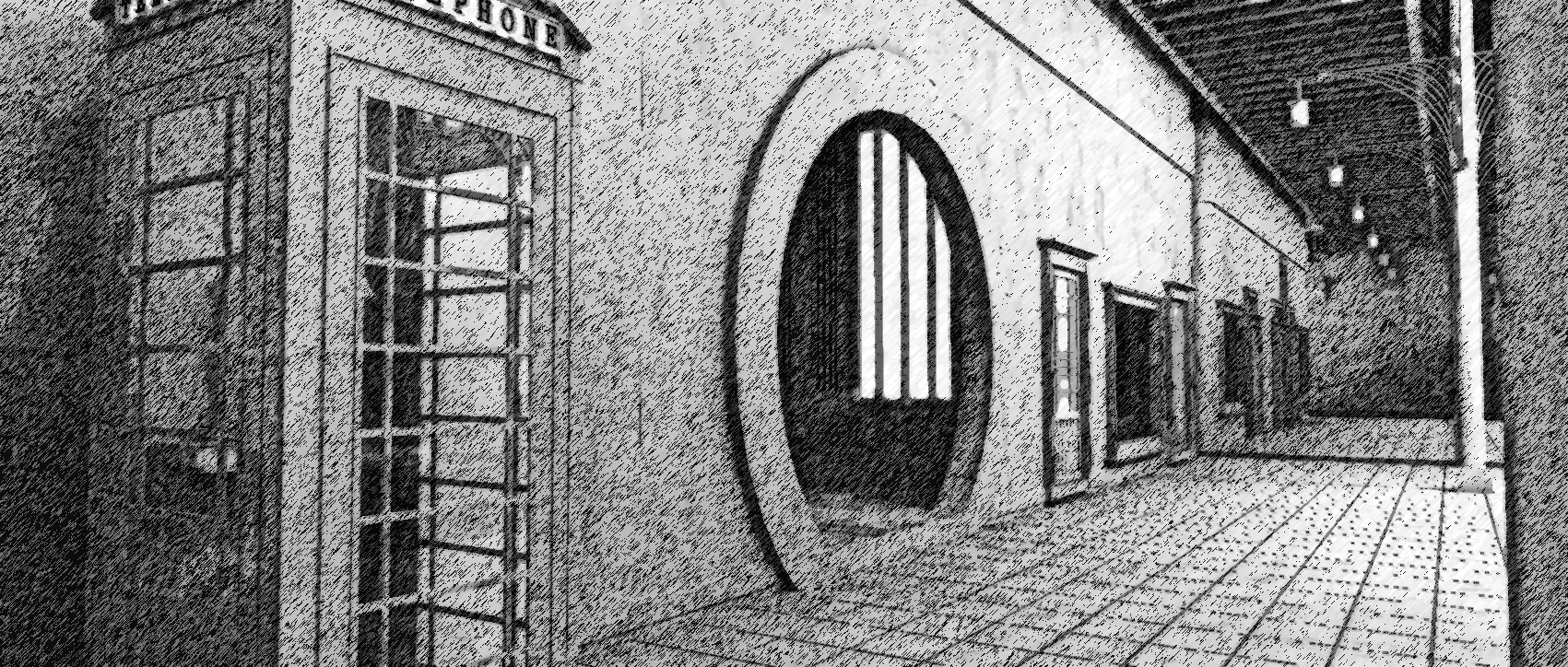
This image provides a greater sense of the scale of the environment thanks to the camera being positioned at roughly head height. Featured is the Chinese style moon gate which leads into the Tea Shop courtyard, and a close up look at the old style phone box.
Phases of Construction
A constant state of architectural evolution means that the centre of many towns are composed of very diverse structures indeed, the remains of Medieval structures and fortifications sit alongside Tudor, Victorian, Edwardian, and contemporary structures creating the distinctive look of urban England. In the towns and villages it is quite easy to divine patterns within the structures, phases in which there was a flurry of construction.
In the metropolitan centres however a somewhat different pattern of building takes place, there is a tendency towards large construction projects during the industrial revolution which involved the replacement of large swathes of inner city with new construction. The skyline of Hingeway is the product of several of these programs of urban renewal, whole swaths of old, even historically significant buildings have been demolished in order to cater for an ever expanding population.
One of the oldest structural elements in Hingeway is the remaining sections of the old town wall which can be seen in the background of this image, this is part of the town fortifications from the age of chivalry, once an outer wall to Hingeway, now an architectural holdover.
The next phase of building comes from the heart of the industrial revolution, in the form of the Tramway, sans the windows which are a later addition. This Victorian building phase involved the demolition of many buildings in order to widen the roadways of Hingeway, it also involves the construction of the raised tramway which spreads throughout Hingeway.
This phase of construction was continued and expanded on during the Edwardian period, with certain considerations to the fashions of the day. The modelled area is one which was constructed during the Edwardian phase, and thus the buildings are in the Neoclassical style of the day, they are heavyset buildings with inwards sloping flat roofs, rounded corners, and many sprouting chimney pots.
The next major phase of changes take place during the 1920s and 30s, during this time the tramway is converted from steam power to electric pantograph. After the conversion a glass canopy added to reduce wind noise for passengers and residents. The 20s and 30s also saw a great influx of immigration from across the globe, each culture bringing with it its own architectural style, and it is here on the edge of Hingeway's Asian quarter that the architecture of the Middle Kingdom has made its mark.
Diversions from History
To be more historically accurate in my representation of the progression of English urban architecture, I should have included influences from Indian architecture, as there has been a greater influence on our culture and architecture from India than there ever has been from The Middle Kingdom; however Indian decorative architecture tends to be very complicated and organic in nature, and while wonderful to look at, it would involve as much work as was involved in the construction of this entire scene to recreate even a small section. Whereas the Oriental style of architectural decoration which I have chosen to reference, is composed of right angles and straight lines, thus lending itself to computer generated 3D images very nicely.